5 Planting Design Techniques for Better Compositions
Learn about small design tweaks that can bring greater balance, cohesion, and flow to any gardenSome gardens feel calm and cohesive, while others, even those with beautiful plants, look cluttered or disconnected. The difference usually comes down to composition: the way plants relate to one another in color, form, scale, and placement.
The good news is that you don’t need a degree in landscape architecture to use composition principles effectively. A few simple, approachable strategies can transform any planting, whether you are refreshing a small garden bed or reimagining an entire yard, into something that feels more unified, expressive, and professionally composed.
"The components that make for good garden design can also be used in changing an existing landscape. Pick a concept or two this year and work on modest changes that will enhance the design of your garden."
— Susan Marquesen, PennState Extension, Principles of Garden Design

The soft gold and yellow colors gently wind throughout this garden, creating rhythm, cohesion, and flow. The Heather Garden, designed by Lynden B. Miller. Photo by: Rebecca Sweet.
1. Use Repetition to Create Rhythm and Cohesion
Repetition is one of the most effective tools in planting design. When the eye encounters the same plant, color, or shape at intervals throughout a bed, it creates a sense of rhythm that pulls the whole composition together. Repetition gives a garden its underlying structure, even when the planting style is loose or naturalistic.
Why repetition works
Plants are wonderfully diverse, and that variety is part of their appeal. But without repeated elements, a garden can quickly feel chaotic or visually noisy. Repetition provides the viewer with something familiar to return to, like a recurring motif that unifies the whole space.
Repetition also helps guide the eye. When a plant or color appears in multiple places, the viewer naturally follows those echoes across the space, creating a sense of movement and flow. This is especially helpful in larger beds or borders, where the eye needs cues to travel through the planting rather than stopping abruptly.
What to repeat:
- Plant species, by repeating a favorite perennial or annual.
- Color, by echoing a hue such as purple blooms or chartreuse foliage.
- Form, by repeating shapes such as mounded, upright, or airy plants.
How to apply it
Choose one or two “anchor plants”, species with strong forms, long seasons of interest, or foliage that looks good even when not in bloom, and repeat them in groupings distributed throughout the bed.
You can also repeat color notes or plant forms to reinforce cohesion. For example, if purple is your unifying color, you might repeat it through salvia, allium, and catmint. Or if you want a calm, grounded feel, repeat mounded forms at intervals to create a steady rhythm.
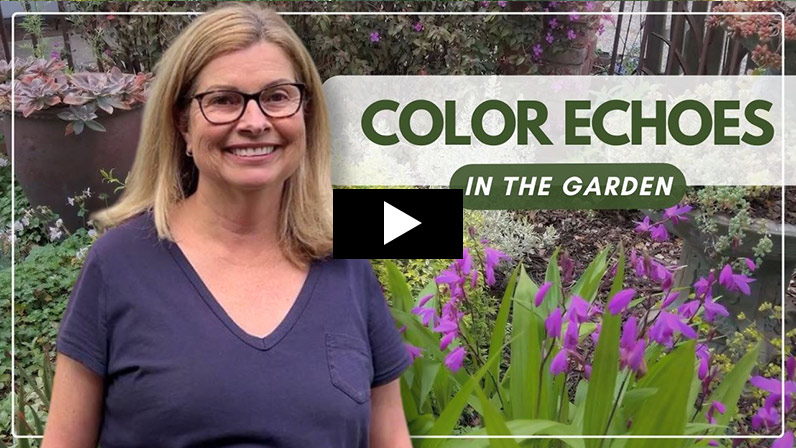
"Think of color echoes as a beautiful ribbon that weaves throughout the garden, tying everything together."
— Rebecca Sweet, Creating Echoes in the Garden
2. Balance Plant Forms for Stronger Structure
Plantings often feel messy not because of color or bloom time, but because the forms of the plants don’t relate to each other. Form is one of the most overlooked aspects of planting design, yet it’s what gives a garden its underlying structure and visual stability. When forms are thoughtfully balanced, the entire planting feels more intentional and grounded.

A boldly textured yucca provides a strong focal point, while surrounding plants with medium and fine textures create balance and contrast. Gardeners: Tamara Paulat and David Pinson. Photo by: Janet Loughrey.
The three essential forms
- Mounded, or rounded, cushion like shapes that create a sense of stability, such as hostas, coral bells, and sedums.
- Upright, vertical accents that add height and drama like ornamental grasses, foxgloves, and baptisia.
- Airy, fine textured plants (sometimes called see-through plants) that weave between their neighbors and add movement and lightness without blocking the view of what’s behind them, such as threadleaf coreopsis, gaura, and verbena.
Why plant form matters
Our eyes instinctively search for patterns and contrasts in shape. When plant combinations lean too heavily on one form, say, all mounded plants, they can feel flat or monotonous. Too many upright plants, and the space can feel spiky or chaotic.
Balancing forms also mimics the structure of natural plant communities. Meadows, prairies, and woodland edges all contain a blend of grounding mounds, vertical accents, and airy connectors. When your garden reflects that balance, it feels more immersive and intuitively pleasing.
How to apply it
Aim for a simple mix of mostly mounded plants, some upright accents, and a touch of airy texture to weave everything together. Upright accents act like exclamation points, drawing the eye upward. Mounded plants create a calm, steady base. Airy plants soften transitions and keep the planting from feeling heavy. In these proportions, the forms work together to create a natural rise-and-fall that feels harmonious and complete.
As you balance plant forms, consider introducing a clear focal point — a plant or object with a distinctive shape or presence that gives the eye a place to rest. A focal point doesn’t need to be large; even a single standout plant or well-placed container can anchor the composition and make the surrounding forms feel more intentional.
"Airy garden plants float effortlessly above, through, and next to plants with more presence, adding height without blocking the view. They bring movement, rhythm, and dimension to a small garden, especially when a soft summer breeze rolls through."
— Heather Blackmore, Here She Grows, My 7 Favorite See-Through Plants for Layered Gardens
3. Create Depth Through Layering
Layering is the secret behind plantings that feel lush and immersive rather than flat. It’s the practice of arranging plants in tiers, from the shortest in the front to the tallest in the back, so the eye moves through the space instead of skimming across it.
The three layers
- Foreground, made up of low growers, such as ground covers, that define the edge and soften hard lines.
- Midground, the main body of the planting where the most color and texture are present.
- Background, composed of taller plants that anchor the composition and give it structure.

Golden grasses in the foreground give way to a dense band of purple agapanthus, with dark shrubs and trees anchoring the background, illustrating how layered plantings create depth and structure.
Why layering works
When done well, layering turns a planting into a three-dimensional composition with depth, rhythm, and flow. Layering also hides gaps and awkward transitions. Bare soil, leggy stems, and abrupt height changes disappear when plants overlap slightly. The result is a more polished, professional look.
Layering is also one of the easiest ways to make a small garden bed feel larger. When the eye travels from low to medium to tall plants, it perceives more distance than actually exists. Just as important, layered plantings support a variety of pollinators, beneficial insects, and birds by offering habitat at multiple heights.
How to apply it
Place the tallest plants at the back of a border (or in the center of an island bed) to create a natural backdrop. Use mid-height plants to bridge the transition so the eye moves gradually downward. Finally, add low, spreading plants at the front to soften edges and cover bare soil. Allow the layers to overlap slightly so the plants knit together into a continuous tapestry rather than forming isolated clumps.
Example: A border with tall Joe Pye weed in the back, mid-height coneflowers in the center, and a drift of creeping thyme at the front creates a gentle low-to-high arc. The layers overlap just enough to feel connected, and the whole space reads as intentional, cohesive, and lush.
"English gardens are known for their unapologetic abundant look, where flowers, vegetables and/or shrubs mingle easily like the very best of friends. This is achieved by layering a range of plants with different heights together, a technique that can be applied from the tiniest garden to the largest estate."
— Karen Chapman, The Layered Garden: Lessons from England
4. Use the 70/30 Rule to Create Balance
The 70/30 rule is a straightforward but transformative design guideline: about 70% of your planting should feel unified, while the remaining 30% introduces contrast and energy. It’s a principle that works at every scale — from a single container to an entire border.

A dense, unified planting of ornamental grasses is energized by a small cluster of red roses, demonstrating how a bold contrast can add visual interest without overwhelming the overall composition.
Why the 70/30 rule works
A planting overloaded with contrasting elements can look chaotic, while a planting with no contrast at all can be flat or monotonous. The 70/30 rule strikes the perfect balance, providing enough harmony to feel cohesive and enough contrast to add excitement.
How to apply it
Let the majority of your plants share one unifying trait, such as a color family, foliage texture, or overall form. Then use a smaller number of plants to introduce contrast: a bold foliage color, a dramatic vertical accent, or a plant with a distinctly different texture.
For example, a bed dominated by soft greens and mounded forms becomes more dynamic when punctuated with burgundy grasses and a few upright accents such as liatris.
5. Repeat Plants in Groups of Three
Odd numbered groupings are a classic design principle because they create movement and rhythm. Groups of three are especially effective — they feel natural, balanced, and visually pleasing without looking overly arranged.

Clusters of purple allium are repeated at intervals across the border, creating the visual rhythm and cohesion that grouping brings to a planting design.
Why threes work
Even numbers tend to form static pairs, which can make a planting feel stiff or overly symmetrical. Odd numbers introduce a bit of asymmetry, which feels more organic and encourages the eye to travel through the space.
How to apply it
Plant three of the same species together for impact. Then repeat those groupings at intervals throughout the planting to reinforce cohesion and create a steady visual rhythm. In larger beds, scale up to groups of five or seven for even greater effect.
You can also echo a color — like yellow blooms or chartreuse foliage — in sets of three to guide the eye. For example, three clumps of yellow daylilies repeated across a border create a rhythm that ties the entire planting together, even if the surrounding plants vary.
Bringing It All Together
These five techniques—repetition, balanced plant forms, layering, the 70/30 rule, and groups of three—work beautifully on their own, but they’re most effective when combined. Together, they create plantings that feel more cohesive, structured, and intentionally composed.
You don’t need to overhaul your entire garden to implement these principles. Start small: repeat a plant you already love, add a vertical accent to a flat bed, or introduce a trio of a favorite perennial. Over time, these simple changes build a garden that feels more unified, expressive, and joyful to experience.

Thursday, October 8th @ 6 PM ET / 3 PM PT
A Walk Through Chanticleer: Inspiration, Creativity & the Art of Seeing a Garden with Dan Benarcik
ABOUT THE AUTHOR
Anne Balogh is a longtime gardening writer and editor for Garden Design, with over 20 years of experience covering everything from container planting to landscape trends. She draws inspiration from her own Zone 5 garden in Illinois, where she experiments with hardy perennials and flowering annuals.
RELATED:
Elements & Principles of Landscape Design
Color in the Garden