
DARK SKY LIGHTING FOR GARDENS THAT RESPECT THE NIGHT
Protect wildlife by reducing light pollution in your yard with these dark sky lighting tipsAs climate change and other environmental concerns have moved to the forefront in recent years, sustainability has become a more crucial component of garden design. Whether creating a waterwise landscape, native garden, or wildlife-friendly yard, homeowners are incorporating more environmentally-friendly elements in their yards.

This garden's owner points out that bats and other night creatures remain active here, a sign the lighting isn’t disrupting the garden’s ecosystem. See more of this Zone 6b garden in Pennsylvania. Photo by: Ami Dushkowich.
With the world’s population now over 8 billion, light pollution, which is an excess of outdoor artificial light, has become a bigger concern, particularly in larger cities. Lights from buildings, cars and street lamps can cause disruptions and health issues for both humans and wildlife.
Dark sky lighting is a relatively new eco-friendly concept that takes into consideration the adverse impacts of artificial outdoor lighting. By utilizing dark sky principles, homeowners can do their part to reduce the harmful effects of outdoor light pollution. Learn more on how to protect the night sky by using dark sky lighting in your own yard.
HARMFUL EFFECTS OF LIGHT POLLUTION
Artificial light from commercial buildings, residential homes, street lamps and car headlights are the biggest contributors to light pollution, broadcasting bright light in all directions. Brighter lights do not always equate to more safety or efficiency.
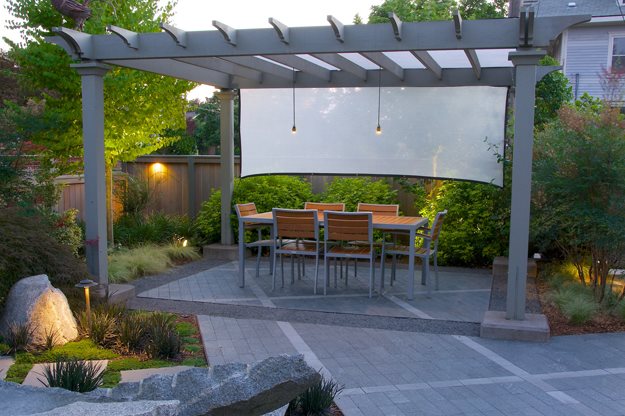
Small, strategically placed lights provide enough illumination for dining and safety without over-lighting the space. Design: David P. Best and Barbara Hilty. Photo by: Janet Loughrey.
Just like us, animals operate on a 24-hour cycle of circadian rhythms. Plants rely on natural daylight to regulate their life cycles. When we flood our gardens with artificial light at night, we disrupt these natural patterns in ways that ripple through the entire ecosystem.
How garden lighting affects wildlife:
- Nocturnal animals like bats, owls, and raccoons avoid brightly lit areas, essentially losing habitat in your yard. Light pollution can impede their feeding and foraging habits and disrupt reproductive cycles.
- Songbirds and diurnal animals may stay awake past their normal roosting time at sundown, disrupting sleeping and feeding routines.
- Migrating birds rely on natural light cues from the moon and stars for navigation. Artificial lights pointing towards the night sky can disorient them, causing birds to veer off course or fly into tall buildings.
Plants face challenges too. Artificial night lighting can simulate longer days, causing plants to emerge from dormancy earlier in spring and hold their leaves longer in fall. This can leave plants more prone to stress from temperature extremes. Also, nighttime pollinators, like moths, may avoid plants bathed in artificial light, resulting in fewer fruits and seeds.

DID YOU KNOW?
Urban lights scatter into the atmosphere, diminishing the visibility of stars, planets and meteor showers. By using dark sky lighting principles in your garden, you can protect your own nighttime stargazing while helping wildlife thrive.
Fortunately, thoughtful garden lighting design can minimize these impacts while still providing the safety and ambiance you need.

The more controlled and downward-focused the light, the less impact it has on the night sky. Graphic by: tales of stars / Shutterstock.
WHAT IS DARK SKY LIGHTING?
Dark sky lighting is a particular type of outdoor lighting that is designed to reduce light pollution, minimizing harm to nocturnal wildlife, migrating birds, and enhancing the visibility of stars.
Here's what to look for when lighting your garden:
- Fixtures designed to direct light downward, preventing light from spilling into the night sky.
- Bulbs that are warmer in color, emitting less blue light, which is more harmful to humans and animals.
- Energy-efficient options with a longer lifespan than traditional outdoor lighting.
Look for the DarkSky Approved seal when buying outdoor fixtures.

A single strand of string lights provides enough ambiance without excess brightness. Hanging lights against a wall helps contain the glow and reduce light spill. Photo by: Ami Dushkowich.
HOW TO USE DARK SKY PRINCIPLES TO REDUCE LIGHT POLLUTION IN YOUR YARD
According to DarkSky International, it’s estimated that 30% of outdoor light illumination in the US is wasted energy, costing billions annually. This waste is primarily caused by poorly directed lighting, over-illumination, and inefficient light controls. Spotlights, uplighting, porch lights, and bright security floodlights that illuminate in all directions cause excessive glare, are more harmful to nocturnal animals, and may also disturb neighbors.
Homeowners and gardeners can help reduce energy usage and the effects of light pollution by using dark sky friendly ideas. Here’s how:
- Use low-glare lighting fixtures that are shielded and pointed downwards.
- Pick LED technology or lower wattage to reduce brightness.
- Limit the amount of light output with fixtures that have smart technology features such as timers, dimmers and motion detecting sensors.
- Think about where lighting is needed and only place lights where they are most used.
- Position lights as low as possible and aim them downwards to minimize glare and light spillage.
- Outline garden pathways for safety with solar lights or efficient LED lights that are not overwhelmingly bright.
- Turn on porch lights when coming and going, and avoid leaving them on all night.
- Use decorative lighting such as string lights sparingly.
- Place and direct lights away from areas where wildlife is likely to feed, nest, and seek protection, such as hedging and tree canopies.
- Design areas of the garden to rely on natural moonlight rather than artificial lighting (learn more about moon gardens).
- Preserve dark areas of the yard where possible.
A landscape design professional or lighting specialist can provide guidance in choosing the best outdoor lighting design and dark sky friendly lighting for your particular needs.
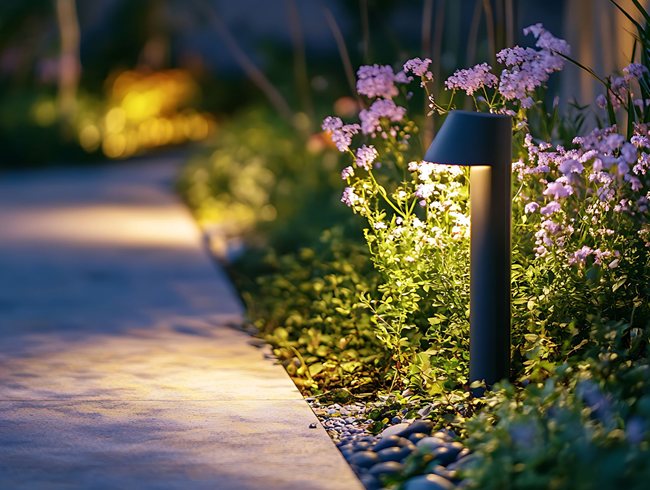
A shielded pathway fixture directs light downward, so people can walk safely, without adding to light pollution.
DARK SKY LIGHTING STANDARDS
DarkSky International has established a set of standards for outdoor commercial and residential lighting to reduce light trespass and the effects of light pollution on humans and wildlife.
Dark sky compliant outdoor lighting includes features such as:
Shields
Light fixtures have top and side shields to reduce the effects of harmful light rays that spill outwards and upwards to the night sky. Shielded lighting fixtures should be installed as close to the ground as possible, and adjusted so they are pointed towards the ground for the least amount of light spillage.
Color temperature standards
Color temperature refers to the color appearance of a light source, ranging from warm (yellow) to cool (blue). It is measured on a Kelvin scale from 1000K (yellow) to 10,000K (blue). Lights on the blue spectrum look similar to daylight, confusing nocturnal animals and disrupting their natural rhythms. Dark sky light bulbs have a warmer color temperature, around 3,000K or lower, which is less harmful to wildlife.
Light controls
Dark sky compliant lighting includes features that allow more control over light levels, such as dimmers, timers and motion sensors. Light output can be set to levels that are functional but not excessively bright.
Efficiency
Dark sky lights include energy efficient LED light bulbs, solar lights, or conventional bulbs that are more efficient, long-lasting and sustainable.

Thursday, October 8th @ 6 PM ET / 3 PM PT
A Walk Through Chanticleer: Inspiration, Creativity & the Art of Seeing a Garden with Dan Benarcik
ABOUT THE AUTHOR
Janet Loughrey is a veteran garden writer and photographer with over 25 years of experience, contributing to major publications like Garden Design, Better Homes and Gardens, and Sunset. A former Master Gardener, she brings hands-on expertise from gardening in a wide range of climates, from upstate New York to the Pacific Northwest.
RELATED:
Backyard Landscaping
2026 Trends in Garden Design
DarkSky International