Duck Hill: Page Dickey's Garden in Upstate New York
A house and garden grow together, with some strategic planning by their owner, Page Dickey, in upstate New York.

Doorways seem the obvious place to start designing a garden. What you see from them becomes the garden's introduction, and the paths that extend from them are an invitation to explore. When I moved with my family 30 years ago to Duck Hill, a 19th-century farmhouse painted yellow and white and perched on the side of a hill in upstate New York, it had no gardens. No flowers at all except for some old, gnarled stands of lilac that bloomed extravagantly in May. Statuesque sugar maples and white ash trees lined the perimeters of the three-acre property, but the interior space, sloping down the hill to the south, was mostly rough grass, with an outlying thicket of scraggly trees. With this virtually empty canvas, I began to plot the garden. I knew I wanted separate areas in which to grow a variety of plants: green rooms, essentially, opening out from the house. It seemed logical to use Duck Hill's doorways as my launching pads.
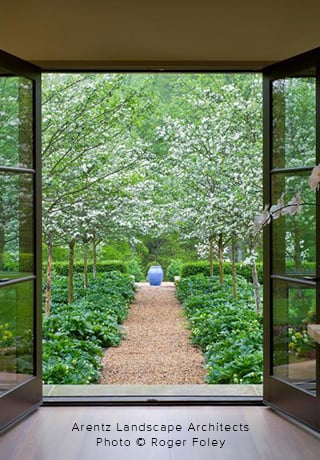
Pictured: A door to a porch leads to a courtyard of Malus 'Snowdrift,' a single-bloom crabapple and Buxus sempervirens 'Vardar Valley,' a hardy boxwood.
Page Dickey's second book about Duck Hill, Embroidered Ground: Revisiting the Garden, was published by Farrar, Straus & Giroux earlier this year. Her first was Duck Hill Journal.
Duck Hill, in North Salem, New York, opened to the public on June 5. Visit gardenconservancy.org/opendays for more information.

That first autumn, I staked out and dug flower beds around a 50-foot-square piece of lawn just below the south side of the house, using the front door as the central axis. Here, I planted old shrub roses and perennials that I had brought from my previous home. A year later, after we had added a kitchen, I began an herb garden outside its French doors. First, low stone walls were built to hold the slope and provide a level space for a gravel terrace immediately outside the house. From there, I put in steps leading up to a series of beds in a geometric pattern. Between the beds I laid gravel paths, ending at an arbor with a bench to stop your eye.
Pictured: A bench at the end of the path in the herb garden stops the eye and offers a place to rest. On the arbor above are roses 'Trier' and 'Silver Moon.'
Get more English garden ideas.

Paths became the crucial link between these first two garden areas. Along the way from the front garden to the herb garden, a small white garden was inserted, with a path that became the link between the south and west sides of the house. Other rooms of flowers were added over the years on each side of the original two, strung together always by a connecting axial path, so that you catch glimpses of one garden from another and are lured on an adventure around the house.
Pictured: A view of the kitchen terrace through the nasturium garden.
See more New York gardens.

The door we all use to enter the house, on its north side, leads into a plant-filled porch off our library. Originally that door spilled directly onto the driveway, where the garage jutted off from the house. But I hated having cars and trucks parked right outside our library windows. After we'd been in the house ten years, I was finally able to reroute the driveway 30 yards away, out of sight behind a hedge. On an axis with the porch door, I created a little courtyard of crabapple trees in boxwood squares. A straight path leads from the new parking area down to this small garden, all green and trim except when the crabapples flower in May and when they are littered with red fruit in the fall. Instead of looking at cars, I now see past the four crabs and past openings in two clipped hedges to a dogwood tree. How much nicer to look out to flowers than to the UPS truck.
Pictured: The kitchen terrace is shaded by a Japanese crabapple, Malus floribunda.

Page's Path Primer
We don't use enough paths in our gardens. Too many American backyards are open lawns that can be taken in at a glance. Paths suggest a journey. As you walk along them, a sense of losing yourself occurs. If you make a path around the perimeter of your property, possibly screening it with trees and shrubs, suddenly your yard seems much bigger and more intriguing.
A drawing of Duck Hill's layout.

When using a path to draw your eye (as well as your foot) into or through a garden, it is good to have something in the distance to end that perspective: a beautiful tree or a welcoming cluster of chairs. A large vase or a sculpture works as well, as can a hint of a view, a patch of sky or sea, even sunlight at the end of a shaded place—anything that arrests your eye and draws you out on that adventure.
Pictured: Rosa rugosa 'Sarah van Fleet' is disease-resistant and fragrant.

Although most of the paths at Duck Hill are straight, they are not rigidly so, because I allow plants to spill into them from the garden beds, breaking the geometry. My paths around the house and on our terraces are a wonderful place to seed. Weeds, yes, but also treasures, and these I allow to remain where they don't intefere with foot traffic. Catmint and Johnny-jump-ups seed in our kitchen terrace along with a tiny cream-colored scabiosa and tall, fragrant heliotrope. Bulbs appear too, unexpectedly—alliums and scillas that have escaped their beds. Delicate orange Atlas poppies crop up in the gravel paths of the nasturium garden and bloom all summer, and a forest of verbascums in yellow and white march along the maze of paths in the herb garden. These are the serendipitous happenings that give charm to a garden.
Pictured: A view of the kitchen terrace through the nasturtium garden.

In the herb garden, a beauty bush, Kolkwitzia amabilis, is in full flower above double dropwort, with Dianthus and cushion spurge, to the right.