Green Elevation
The irony in building a home on a steep hillside is the difficulty in carving out the footprint of the structure without damaging the natural beauty that inspired the construction. But when landscape architect Richard Shaw of Aspen-based Design Workshop approached this project in the Rocky Mountains near Woody Creek, Colorado, working closely with Poss Architecture + Planning, he knew there was a way to minimize the impact while maximizing the views and assets of the surroundings.
Creating a perimeter of thick walls defined the building space and protected nature outside that boundary. The rich palette of plants in the local aspen forest was then brought up to the walls and into garden areas. Taking this process to the next level, the plant mixes used, developed specifically for this project, were attuned even to altitude and orientation.
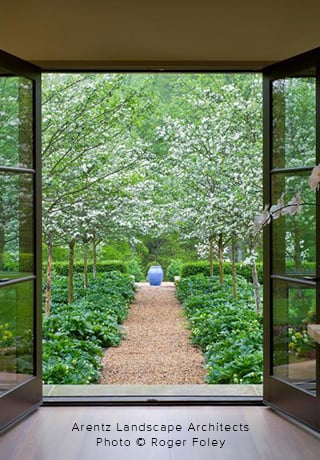
Connecting indoors and outdoors was the guiding force in the design of both house and garden. Says Shaw, "The landscape was not a slave to the architecture," and the design was a collaborative effort between landscape architect and architect. From inside, designed and natural landscapes, intimate spaces and breathtaking vistas, can be seen from every room and at every level. Even outside, strategic gaps in garden walls frame views. Indoor living areas are on a level with outdoor living areas and garden spaces, making for easy transition. At the heart is a courtyard for entertaining, with a central pool and a garden space of lawn and perennials that is also a green roof over service areas. A tenting option for the terrace means the party can go on even with frequent afternoon showers.
Another of Shaw's goals was to explore the "states of water and how it can move." Emerging as mist from a granite slab in the entry courtyard, cascading from walls like snowmelt, traveling along runnels, reflecting the scenery in still pools, water becomes, visually and thematically, a connective tool, linking created and natural habitats. For more information, call 970-925-8354 or see designworkshop.com. - Jenny Andrews
Hot Tub Magic
Every bachelor crib should have an Austin Powers moment, and the hot tub cover in this sleek urban space in San Francisco, by Surfacedesign Inc., delivers. A three-sided ipe box, the cover, when moved off the tub, slides on steel rails for 40 feet through the garden, the fairer ipe contrasting with horizontal California redwood walls darkened with Cabot stain. As it rolls, the cover morphs into three features. One, when the tub is in use, it offers a deck for sunbathing and toe dangling. Two, rolling toward the house, it enters a planted zone, providing a modernist frame for hellebores, spring bulbs and box hedges. Three, docked at the dining terrace, the cover is the perfect bar-height surface for a post-soak mojito while watching the cook. For more, call 415-621-5522 or see sdisf.com.
- Joanna Fortnam
On Tap
Once the source of drinking water for a small town near Dallas, this abandoned pumping station in Highland Park is now back in circulation. Its new incarnation, designed by landscape architects Mary Ellen Cowan of MESA and Julie Bargmann of D.I.R.T. Studio, is a postmodernist celebration of industrial architecture, a preservation of local history, and a lively combination of art space and residences. Under the impetus of the property's owner, what could have been a forlorn, derelict site has been transformed into something welcoming and inspiring. Appropriately and symbolically, the site's lifeblood is water, used like an artist's medium throughout, in ground-level misters, spillways and fountains, with its fluidity juxtaposed beside the solidity of concrete structures. The Turtle Creek Pump House is also a showcase of sustainability - a sod roof of buffalo grass, native plants, a permeable motor court of pavers and grass (right). Even original mechanical elements found new life, such as benches made of electrical panels and a well-head table. Beyond simple salvage, the pump house site is a renaissance and an example of ultimate recycling. For more information, call 214-871-0568 or see mesadesigngroup.com.
- Jenny Andrews
Kiss the Sky
Story upon story above the hum and clatter of Manhattan, a rooftop garden by Sawyer/Berson Architecture & Landscape Architecture is a flawless set for fair-weather parties that have kept growing in frequency and size since the design project was completed. "Our client, an old friend of mine, likes to have weekend guests and get-togethers - he loves nothing more than to cook and entertain. He wanted a space to accomodate a lot of people," says founding principal J. Brian Sawyer. "So we designed a serious outdoor living space. We basically created the same program outdoors as he has indoors in the penthouse." Every site has a story - this one is no different. As required by the building management company, the entire installation had to be designed to be disassembled and removed. "The entire thing sits on four columns, not touching parapet walls, the elevator bulkhead or any-thing. Basically, we made a steel deck on top of which everything sits," says Sawyer. Despite its modular nature, the garden has a feeling of permanence.
When he first came to Sawyer, the client knew he wanted a change beyond the standard rooftop terrace. "He just didnšt know how far he wanted to go with it," says the designer. The architects were ready with a quiver full of ideas. "We were very influenced by Paul Rudolph's recent renovation of the East River townhouse, Beekman Place, and the way it uses exposed steel to engage the urban environment." Let it be said that Rudolph is known best for creating seamless indoor-outdoor residences along Florida's Gulf Coast, which established the Sarasota School of Architecture, and that the magic of those houses and their landscapes is translated to this kindred garden on a Manhattan rooftop, a thousand miles away.
The view is different, too. Trade the mellow blue-green Gulf for a landscape of water towers poking into the horizon. But no one's complaining. "It is one of our most successful projects in that it is used exactly for the purpose it was designed for and even more. Entertaining in the garden is the central part of his life. I've seen him cook for 100 up here," says Sawyer.
The kitchen's lustrous black granite counters and Lynx 42-inch grill do make for a compelling cooking experience.
Instead of conflicting with the industrial view, the garden aims to work with its surroundings through its use of steel and concrete for structural elements and surfaces. The water tower relates to many in the distance. Yet the feeling of a retreat is still present, established by comfortable furnishings and richly layered planter boxes. Ralph Pucci furniture designer Chris Lehrecke custom- designed some pieces, including sofas and lounge chairs. The dining table and chairs inspired by French architect Jean Prouvé were designed by the firm. The plant palette was borrowed from gardens you'd find in the Hamptons near the beach where the wind and weather give the vegetation something to think about. Says Sawyer, "We knew those plants could handle the weather." Northern bayberry, herbs such as sage, thyme, rosemary and lavender, inkberry, and the creamy white panicles of 'Tardiva' hydrangea growing in planters and black, concrete Lunaform containers tone down the edges of the garden while standing up to windy days in New York. For more information, call 212-244-3055 or see sawyerberson.com.
-Sarah Kinbar
Silent Treatment
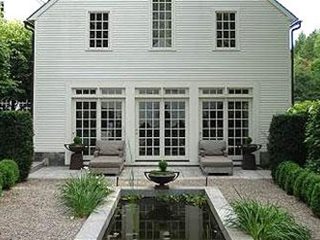
Although it's often taken for granted that a garden gets better with age, it isn't always true in reality. However, according to Bruce Eckerson, principal designer for Wesley Stout Associates, this "Shaker Modern" garden in Westport, Connecticut, has most definitely improved over time, thanks to its "inherent structure and simplicity." He explains that "great clients" (both of whom are themselves designers) and "a location with a strong traditional identity" were the serendipitous combination that produced a successful alchemy of classic and contemporary.
The owners' collection of mid-century modern furniture initially intrigued Eckerson; he was impressed at how naturally they settled it into the pared-down interior of their traditional New England house. This sparked the realization that his essential task as designer of the garden was to "take the traditional skin of the house and put a contemporary twist on it," and he adhered to this principle consistently throughout the design process. The stern, simple public face of the house offers barely a hint of a whole other world of intimate entertaining spaces and garden rooms beyond. In this property of just under an acre, the key to creating harmony was a precisely defined and detailed concept. And that was how Eckerson and his clients arrived at the mantra "simple, subtle, sublime and silent." Having distilled their vision, they followed through rigorously.
Starting with the entrance through the garden gate, the design works to both conceal and reveal the site. The outdoor "foyer" contains a long, narrow koi pond that soundlessly reflects the pure geometry of the house and garage.
This room unfolds onto the dining court, which is the central outdoor space with a dining table under the canopy of four linden trees flanked by a 20-foot-long water wall. A cantilevered granite staircase anchors the corner of the court, ascending the nine-foot grade change up to the pool, play lawn and outdoor living room. The outdoor living room is nestled in the corner of the house framed by the master bedroom suite and the exercise room. With direct access out from both rooms, the outdoor living room is an extension of these interior spaces. A large outdoor fireplace anchors the space.
The owners particularly admire designers Russell Page and Dan Kiley and Eckerson refers to them both. Page's special gift of combining French-inspired formality with relaxed touches of wildness and intimacy came to the fore in the arrangement of rooms around different social functions - dining, sitting and swimming. Kiley's modernism appears in the expression of boundaries and volumes - spaces overlapping, trees massed together, mowed edges to delineate spaces.
Eckerson deliberately limited the palette of landscape materials; strict editing was second nature to the clients and thus key to the garden they wanted. To visually reinforce the interconnection of outdoor spaces, granite was used for paving and walls. Stainless-steel railing, granite finishes, teak furniture and handrails, and a policy of mostly white flowers (plus a few blue) ensured the look remained in line with the original "Shaker Modern" idea. Clipped hollies and boxwood with white hydrangeas and rhododendrons predominate; busy perennial borders were considered at odds with the guiding aesthetic. The result is a harmonious and highly personalized place. Like a beautiful piece of Shaker furniture, the outdoor spaces are joined and finished in a simple, functional way that reveals a unified vision. For further information, call 203-966-3100 or see wesleystout.com.
Designer Bruce Eckerson shares his interpretation of the tenets of modern Shaker design:
SIMPLICITY: Constantly work to pare down the design to its most essential, elemental components. Eliminate unnecessary flourishes. SILENCE: Not quiet in the audible sense, but in the feeling that all elements of the garden are where they should be. Nothing is out of place. No one element is more important than the whole. MATERIALS: Keep the palette to a minimum and repeat them throughout. An excess of materials dilutes the overall strength of the composition and can create visual clutter. WATER: Essential in the garden, water can be used in tight, reflective sheets in contemplative rooms or actively in fountains to create soothing white noise. Avoid loud, crashing fountains. PLANTS: Use simple evergreens like boxwood or holly to reinforce the structure. They also provide a clean counterpoint to flowering plants.
- Joanna Fortnam
Sky's the Limit
During the day, you wouldn't know how carefully this garden in Faqra, Lebanon, was crafted to create nocturnal ambience. With lighting fixtures completely concealed in the landscape, the touch of a button that lights up fire pits throughout seems like magic a la Mindfreak. Based in Broumana, Lebanon, this year's winner of the ASLA/Garden Design Residential Award of Excellence, Vladimir Djurovic is an illusionist in his own right, engaging Lebanon's endless sky by deconstructing it and piecing it back together as vast terraces and crystalline pools. The residence's owner, renowned fashion designer Elie Saab, must be in his element in this garden. Djurovic says the landscape is meant to show "how simplicity in design and well-crafted execution leave behind a sense of presence." One could say the same of Saab's own designs. Something in the landscape's elegant scale and perfect hardscape detailing connects to the fluid fabrics, angular cuts and sky-inspired colors of Saab's couture collections. For more information, email info@vladimirdjurovic.com or see vladimirdjurovic.com.
-Sarah Kinbar |