Glorious Hedges
Garden design is pushing the boundaries of the hedge and its role in the modern-day garden.
One of the classic instruments of garden design, hedges are, unfortunately, often overlooked in contemporary landscapes. Yes, Europeans have used living fences for centuries to enclose great estates, define and divide small plots, and block unsightly views. And Americans have long planted hedges to impose order — first on the wilderness, later on the suburban tract. But it is only in recent years that landscape designers on both sides of the Atlantic have begun to experiment again with this versatile tool.
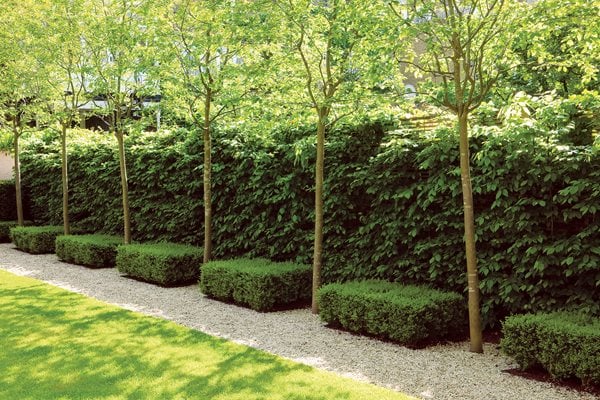
Above: A petite urban oasis in St. John’s Wood, London, designed by del Buono Gazerwitz, uses a green fence to ensure privacy while creating the illusion of space. The layering of heights, colors, and textures—hornbeam hedge overlaid with Amelanchier ‘Robin Hill’ trees and clipped box topiaries—adds visual interest while providing a clever way to get around fence height restrictions.

Crafted from a wide variety of plants, today’s hedges assume forms from low and serpentine to sculptural and monolithic. Modernists added perennials to the hedge list, using rows of grasses to define properties or create screens. Hedge-coveting pragmatists opt for a fast-growing mix of shrubs like viburnum, clethra, and hydrangea. These plants reach 10 feet tall in less time than it takes to grow a medium-size yew and offer a The Wind in the Willows hedgerow effect. Lovers of the classics still gravitate toward a single straight line of deciduous or evergreen trees (for those concerned with privacy), which creates the vertical oomph of a great wall. Contemporary designers borrow a trick devised by Victorians—creating “tapestry hedges,” consisting of a visually interesting mix of trees and shrubs in various shades.
Above: At an East Hampton, New York, property, mature arborvitae planted in an undulating row sets a visual note that is echoed in the shape of the bench and the mowing pattern of the grass.

Whichever material is chosen, it’s important to remember that a living fence bridges that space between architecture and garden. “When we’re planning a landscape,” says Eric Groft of Washington, D.C.-based Oehme, van Sweden & Associates, “we start by looking at the architecture of the place, the bones and details, because we want to gracefully transition from house to nature. And then, of course, we choose something that deer aren’t going to eat.”
Abovet: In London’s Hampstead neighborhood, landscape designer Lynne Marcus created an espalier of hornbeams to screen from the road an elegant parterre filled with box-edged beds of daffodils, tulips, and allium with an 100-year-old yew as its centerpiece.
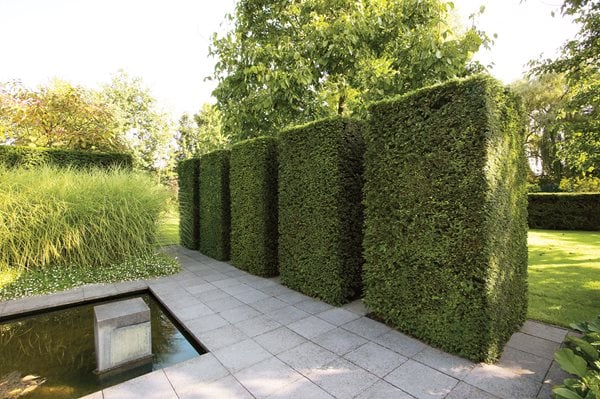
Neat rectangles of clipped English yew stand adjacent but not connected in one of Mien Ruys’ legendary gardens in Dedemsvaart, Netherlands. The plants form a green wall visually reminiscent of a common border hedge but entirely different—imposing but permeable. Light, air, and people can pass through. Ruys’ use of a living fence to divide a garden internally demonstrates how simple plantings can influence how we experience a space.

A sheared fastigiate European hornbeam hedge (under-planted with liriope) lines a driveway in Villanova, Pennsylvania. Designer John Shandra of Gale Nurseries wanted to create a sharp, clean line between public and private space.

At the height of the season, ornamental grasses create a soft and fluid effect while screening out neighbors and traffic. Here, Miscanthus sinensis ‘Yakushima Dwarf’ creates a divide at Marchants Hardy Plants nursery in East Sussex, England.

Plants have been snaking their way up walls for millennia, but it was French botanist Patrick Blanc who in 1988 at Paris’ Museum of Science first popularized the “vertical gardens” that now appear in chic landscapes everywhere. Blanc’s design—plants grow in a soil-free system comprised of felt, metal, and PVC—allows stunning horticultural displays to thrive in unusual settings, including the sides of multistory buildings and towering highway bridge overpasses. Like hedges, vertical gardens can have a major aesthetic impact, especially in places like urban backyards where ground space is at a premium. But be forewarned: Blanc-like tapestries can require tremendous upkeep and copious amounts of water. For those desiring a simpler approach, there are a handful of DIY products, including the pretty planters Woolly Pocket makes. Another simple way to create a green wall: climbing vines. They may be nothing new, but vines are time-tested and low-maintenance.
For more images of vertical gardens, see our slide show "Vertical Gardens." And for more about Patrick Blanc's orchid vertical gardens, read "NYBG Orchid Show."