Andrea Cochran's Landscapes
Emotion and restraint weave through Andrea Cochran's well-edited landscapes—a look at some of the landscapes that she has designed, as well as our exclusive (and extensive) Q&A with Cochran.

Landscape architect Andrea Cochran may have grown up in suburban New Jersey, but she strongly identifies with the West Coast, where she’s lived and practiced for the last 30 years. Her highly sculptural and modernist designs consistently garner media attention and awards; since 2004, in fact, the only year she didn’t win an honor from the American Society of Landscape Architects was the one in which they asked her to be a juror.
Like her work, Cochran is both elegant and warm, and that delightful paradox shows up in projects that include museum sculpture gardens, housing project courtyards, and children’s play spaces. Last July, she collaborated with the architect/artist Susan Narduli in a competition-winning design for the San Francisco Veterans Memorial, which is slated to open in the fall of 2013. Garden Design caught up with Cochran recently to dig below the surface of her clean, crisp designs in order to better understand the aesthetics and process of this walking force of nature.
Our slide show of Cochran's landscapes is accompanied with a Q&A with Cochran.
Sourcebook: Andrea Cochran Landscape Architecture is based in San Francisco (415/503-0060); acochran.com). A collection of her work, Andrea Cochran Landscapes, by Mary Myers is available from Princeton Architectural Press.

Garden Design: You moved to the West Coast 30 years ago with the plan to stay just a few years. What happened?
Andrea Cochran: When I first came here, someone asked what I did and it was the first time I had ever told anybody I was a landscape architect when they didn’t say, “My holly bush has dots on the leaves.” I didn’t have to explain that I design gardens; I’m not a horticulturist. This was the culture of Thomas Church and Sunset magazine, where people could name a landscape architect. Coming to the Bay Area was very freeing; I realized I’m able to do more here. I don’t think it’s an accident that Silicon Valley or Berkeley in the ’60s happened in California. There is a culture of innovation here. Combine that with a climate where everything grows and where people spend a lot of their time outside: They’re invested emotionally in their landscape.
Left: Cochran’s ability to blur the line between natural and man-made environments is evident at Stone Edge Farm, a Sonoma residence, olive grove, winery, and garden.

GD: How do setting and size shape a project?
AC: We work on everything from urban courtyards to vineyard/hotel complexes that are hundreds of acres, and each takes a very different approach. Urban landscapes are about architectural spaces. It really becomes an outdoor room connected to the architecture. The landscapes are generally more hardscapes, almost idealized, where we bring in the sense of nature in a very controlled but not-trying-to-copy-nature kind of way.
On a suburban project, I’m really thinking about the edges of the property, about how to fool the eye to make the space seem more permeable with a larger environment. What I don’t want to do is create a box. So I’m thinking a lot about how those edges define space and about screening and light. When we get to a more rural landscape, then I’m thinking of the zone around the house as being very architecturally defined.
Cochran often uses reflecting pools, here flanked by 100-year-old olive trees at Walden Studios, a vineyard and arts facility in Sonoma County, California.

GD: Your work feels so sculptural. Do you have favorite sculptors?
AC: The people who influenced me are minimalist sculptors, mainly working in the West, who really have thought about their art not as a piece in a museum but as an environment. Like Donald Judd, who was constantly asking what is the boundary between a sculpture and the place where it sits? Robert Irwin, early in his career, suggested space by running a violet chain-link fence through eucalyptus trees so it becomes part of the landscape. Or Walter De Maria, who did The Lightning Field—a grid of poles 20 feet high in the high desert of New Mexico.
GD: Any favorite landscapes?
AC: One of the most powerful spaces I’ve been to is the Pantheon in Rome. I’ve seen people standing there with tears in their eyes. Also Delphi (in Greece), which is a ruined landscape but also the most sacred, spiritual place. You can feel a sense of power, a primitive, deep connection. I do think that the ancient people picked places to put their work because they were sacred. So that’s on the woo-woo level.
But then think about Paley Park in New York. What could be a better place? Small, small, but a little urban oasis with its water wall and the canopy of the trees.
Andrea Cochran’s propensity for clean lines, geometric balance, and subtle colors is on display in this garden at a residence in Atherton, California, including a large stone fireplace that forms an essential part of an outdoor living room.

GD: You were quoted in The New York Times saying, “There is no narrative and no irony in my work.”
AC: I’m interested in places you respond to on the emotional level. I’m not really an intellectual, so I’m not interested in playing with puns or jokes, whether they be highbrow or lowbrow. I’m not into thinking about the intellectual part of what the landscape is. The art I like in galleries no one needs to explain to me; it’s like someone punched me in the gut.
Terraced gardens above a gray stone retaining wall maintain a subdued color palette and demonstrate Cochran’s method of introducing permeable edges that meld with the surrounding environment.

GD: You’re a big editor of spaces, aren’t you?
AC:?We call it taking the tchotchkes off the mantel. I worked on one renovation where there were all these pine trees planted around the house. They’re not terribly long-lived trees and are a fire hazard, so we took them out before we even designed anything. And we discovered an amazing view of a native grassland. Then we looked at what was left and decided what to take out next. It’s like peeling back the layers of the onion until you get to the essentials, then you add back. You can edit to the point where there’s nothing left—that’s a fine line to walk—but you are really trying to reduce it to its most essential qualities: How do we let light in; what’s going to happen over the seasons; will that be backlit?
GD: Is there a particular user experience you aim for in your designs?
AC: We’re trying to make spaces that feel right and feel connected to place: Sometimes they might be more contemplative or playful or about feeling safe. There’s a theme of simplicity that runs through the work but the projects look different. At least I hope they look different.
The addition of an elegant outdoor dining space means the family that lives here spends far more time in their backyard, in this residence in Atherton, California.

GD: Has your style evolved over the years?
AC: Definitely. As I’ve gotten older and built more confidence, I don’t feel like I have to use all my tricks in every project. The editing becomes more unequivocal. On the other hand, it would be terrible to say I’m not learning. I’m learning all the time, trying out new plant material or ways to make things more sustainable, which could be irrigation or materials or plants.
GD: There’s obviously so much care given to material selection in your work. Why do we see so much Corten steel?
AC: For me, Corten feels like it’s of the earth. It allows us to sculpt the earth, and it’s very narrow, so you don’t see the wall; it becomes a plane. A concrete wall is 6 inches deep—if you’re lucky—but it still feels like this big other thing in the landscape. When I’m working with Corten, I feel like I’m carving into the land and sculpting it. I’m very much a minimalist, but I really like things to have a patina. It changes as it rusts, so it’s also expressing the passage of time.
Cochran often includes water elements in her designs, ranging from thin sheets to full-on pools, explaining that she likes the way water reflects changes in light, weather, and time of day.

GD: You often blur edges with plants. What are some particularly suited to this task?
AC: Grasses are great because they can be backlit. They’re more diaphanous than a hedge, and they move with the wind, so they’re engaging the larger environment. Bamboo is a wonderful edging, as is anything that you can see through or that has a scrimlike quality.
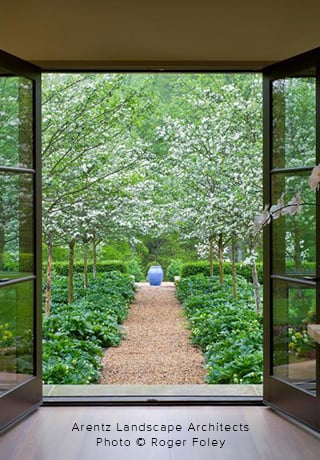
In front of this Atherton, California, residence, an allée of linden trees, viewed from the front door of the residence and ending at a stacked-quartz fountain. The allée serves as a transitional space between a public road and the private home.

GD: Do you have favorite plants?
AC: I use hellebores a lot because they’re evergreen. They’re not really a ground cover; they have some mass. They fill a space, but they’re not so manicured. They have a nice sense of presence, spatially. You get the benefit of those fabulous chartreuse flowers. My particular favorite is the Corsican hellebore, Helleborus argutifolius. I’m a sucker for anything in the blue-gray family. I also love Euphorbia wulfenii because I love chartreuse. If you go blue-gray with chartreuse: home run. There are certain plants you can’t not like: What’s more beautiful than Japanese maple? Or Magnolia soulangiana? Those beautiful branches.
At a private residence in Pebble Beach, California, which Cochran created together with Pacific Peninsula Group, an outdoor dining area takes full advantage of inimitable Pacific Ocean views, and a concealed grill hides in the back of the limestone fireplace.

GD: When should people hire landscape architects?
AC: A lot of people like plants or materials, but they don’t know how to create space. That takes training. Also, a landscape is outside; it’s living and changing, so you need to think about things like drainage and plant placement. If people really don’t know plants, it’s like buying a puppy: It’s cute when you bring it home, but then it turns into a 150-pound monstrosity. You need the knowledge of what the plants end up being; you don’t want The Little Shop of Horrors. My pet peeve right now is green walls. They’re so hot, and every time I meet with someone, they say, “Let’s do a green wall!” I say, “A, it’s expensive to put in, and B, it’s not like wallpaper, you need to take care of it—there’s a maintenance quality to it you don’t understand. You can’t just slap it up and walk away; it’s a commitment.”
At the same Pebble Beach, California, house, an east- and south-facing patio allows natural light into an indoor basement entertaining area. Planters and sculptural balls made of willow enliven the space.

GD: What does it cost to hire a landscape architect?
AC: A rule of thumb on residential landscape projects is that somewhere between 15 and 20 percent of construction costs go to design. The smaller the project, the higher the percentage. Also, less paving and fewer walls mean lower cost because they take less time to design and draw. In the Bay Area, people are prepared to pay for design because it’s of value to them. In Chicago, people value construction, so landscape architects do a lot of design-build.
A stand of precisely planted ornamental pear trees frames a view of the rolling landscape around Baker Lane, a Sonoma residence that’s also home to an oil-producing olive orchard, vineyard, and organic garden.

GD: Where is the field headed?
AC: Highly visible projects like the High Line in New York and Millennium Park in Chicago brought landscape architecture to a much more visible level. Now on some projects, the landscape architects drive the design team with architects coming later, which I think is very exciting. I think we’re thinking in more holistic and environmentally connected ways, and people in my field have always focused on systems rather than objects. It’s a wonderful time to be a landscape architect.
Atop a bed of gravel, a material Cochran favors for its easy maintenance and low environmental impact, arced rows of boxwoods mimic the curvature of the vineyards surrounding Baker Lane and offer a labyrinthine play space for children.